
Virtual Assistant vs Administrative Consultant and Benefits for Private Practice in Canada
Many clinic owners assume that hiring remote administrative help means signing up for basic task execution, where an assistant simply waits for instructions to type letters or answer phones. In reality, modern remote support spans two distinct professional profiles that serve different operational needs in a Canadian private practice. Understanding the functional differences between a virtual assistant and an administrative consultant helps practitioners choose the right support model for their specific clinic workflows, scheduling demands, and growth targets.
The distinction between these roles is functional rather than legally regulated, as administrative titles are not uniformly codified under Canadian statutes. Professional groups like the [Canadian Association of Virtual Assistants] outline business-support roles focused on recurring daily operations, while specialized bodies such as the Canadian Administrative Professional Certification Overview point toward broader advisory, workflow redesign, and project-based competencies. Knowing how these roles diverge lets clinicians match their current operational bottlenecks with the right tier of external expertise.
Defining the Virtual Assistant Role in a Clinic Setting
A virtual assistant typically focuses on recurring, day-to-day execution. Clinics hire virtual assistants to manage predictable administrative workloads such as patient intake coordination, email triage, calendar management, and appointment reminders. This execution model suits practices that already have established protocols but lack the internal hours required to keep pace with incoming inquiries and routine correspondence.
Outsourcing routine operations gives a private practice flexible capacity without requiring a full-time, on-site employee. This approach fits practices experiencing variable patient volume, limited physical office space, or fluctuating administrative demand. Delegating these duties allows clinicians to spend more hours on direct patient care while improving overall responsiveness for prospective clients trying to book a session.
Defining the Administrative Consultant Role in a Clinic Setting
An administrative consultant operates at a structural level, analyzing how a clinic functions before designing new systems or fixing operational friction points. Rather than executing daily tasks, a consultant evaluates existing scheduling software, billing pipelines, patient intake funnels, and communication channels to build scalable workflows.
Practices typically engage consultants when facing major transitions, such as migrating electronic medical record platforms, expanding a multidisciplinary team, or redesigning internal privacy policies. The consultant establishes the blueprint, documentation, and quality checks, leaving the routine maintenance to internal staff or a virtual assistant once the new system is fully implemented.
Choosing Between Execution and Strategic Advisory
Deciding whether to hire a virtual assistant or an administrative consultant depends on whether the practice suffers from a lack of daily hands or a lack of efficient systems. A clinic drowning in unreturned emails and unconfirmed bookings needs execution capacity, making a virtual assistant the immediate priority. Conversely, a clinic where staff members duplicate tasks, make frequent scheduling errors, or struggle with inconsistent recordkeeping needs a consultant to diagnose the root causes and build standardized operating procedures.
Many thriving practices combine both approaches over time. An administrative consultant might spend a month auditing and rebuilding the practice systems, followed by a virtual assistant who steps in to run those newly established routines day after day.
Privacy Obligations and Regulatory Responsibilities in Canada
Delegating administrative tasks to external contractors requires strict adherence to provincial and federal privacy frameworks. In Canada, the health information custodian or primary practitioner remains legally responsible for patient records, regardless of whether those files are accessed by an on-site receptionist or a remote contractor.
According to guidance provided by the Canadian Medical Protective Association Privacy and Confidentiality Guidelines, practitioners must implement reasonable administrative, physical, and technical safeguards when utilizing electronic communication and remote administrative support. Any external contractor handling personal health information should sign a comprehensive confidentiality and data protection agreement outlining strict data retention, breach notification, and secure destruction protocols.
Maintaining Data Security and Least Privilege Access
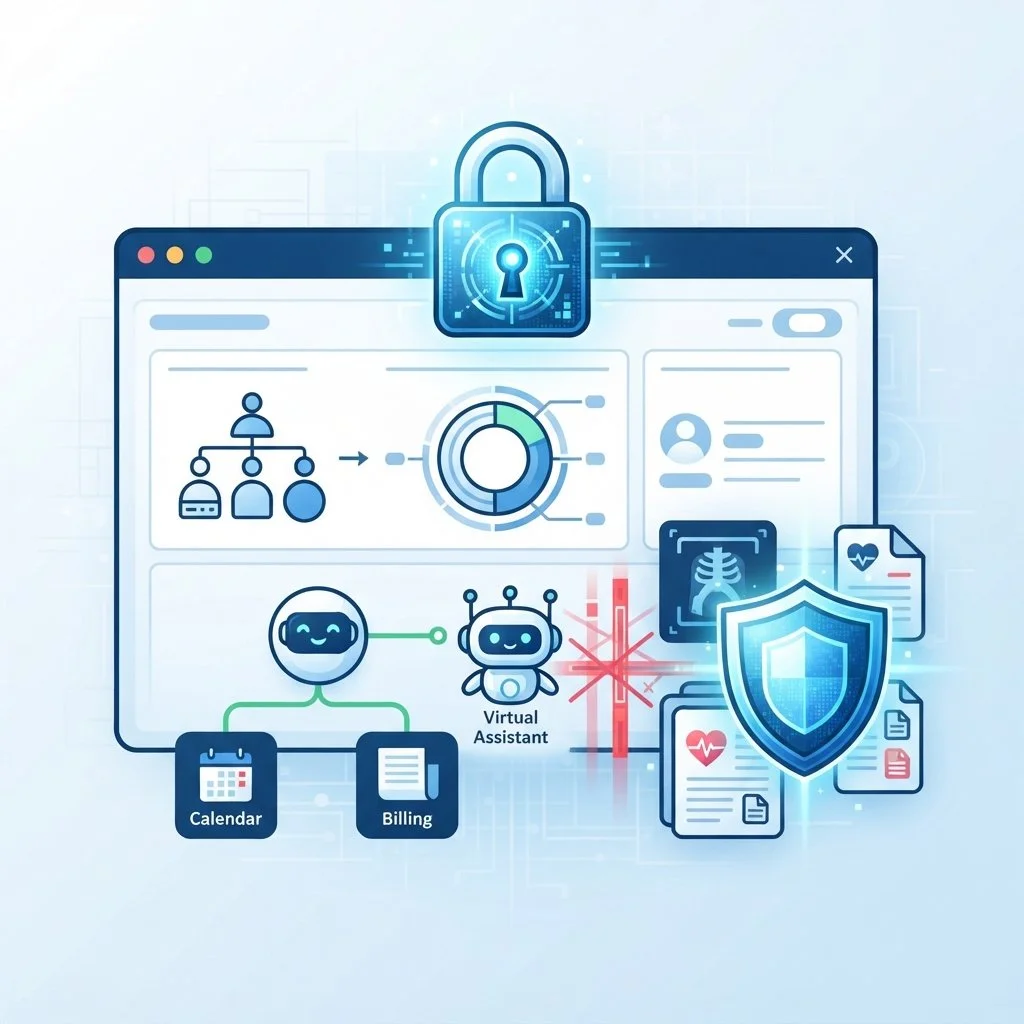
Protecting sensitive patient data involves limiting remote access strictly to what is necessary for job performance. Adhering to the principle of least privilege means a virtual assistant managing calendar bookings and billing inquiries should not have unrestricted access to clinical diagnostic notes or full patient charts.
Practices must also evaluate their communication channels. Ordinary consumer email and standard text messaging often fall short of required privacy standards unless encrypted through compliant platforms. Regulators emphasize that patient consent for electronic communication does not remove the practitioner's underlying duty to secure health data during transmission and storage. Reviewing standards set by regulatory bodies such as College of Alberta Psychologists and Alberta College of Social Workers can helps clinic owners verify that their remote delegation practices align with current legal mandates. For additional context on protecting information during remote operations, exploring resources on CMPA Virtual Care Advice provides practical risk-mitigation strategies.
Key Takeaways
- Virtual assistants focus primarily on recurring, day-to-day administrative execution like scheduling and inbox management.
- Administrative consultants specialize in systems design, workflow redesign, and operational diagnostics.
- Health information custodians retain full legal responsibility for patient data managed by external contractors.
- Implementing least privilege access ensures remote staff only view information necessary for their specific tasks.
- Secure, encrypted communication channels are mandatory when sharing patient details with remote administrative personnel.
What is the main difference between a virtual assistant and an administrative consultant?
A virtual assistant executes recurring daily tasks such as scheduling and data entry, while an administrative consultant provides high-level advisory services, systems design, and workflow optimization for the practice.
Can a virtual assistant handle sensitive patient health records?
A virtual assistant can access patient information only if bound by strict confidentiality agreements, proper security protocols, and strict adherence to the principle of least privilege required by provincial privacy legislation.
Who is legally responsible if a remote contractor breaches patient privacy?

The primary healthcare provider or designated health information custodian remains entirely responsible for the collection, use, disclosure, and security of patient information handled by external service operators.
When should a private practice hire an administrative consultant?
A practice should hire an administrative consultant when experiencing systemic workflow bottlenecks, transitioning to new digital platforms, or needing standardized operating procedures built from scratch.
Do virtual assistants require specialized healthcare training in Canada?
There is no universal legal certification required to work as a medical virtual assistant in Canada, but hiring providers with verified administrative experience and knowledge of health privacy laws is strongly recommended.
How do privacy laws affect remote administrative support in Canadian clinics?
Privacy laws like PHIPA in Ontario or equivalent provincial legislation require practitioners to vet external contractors thoroughly, ensure secure data transmission, and maintain documented agreements regarding privacy compliance and breach reporting.
---
This article is for information purposes only
