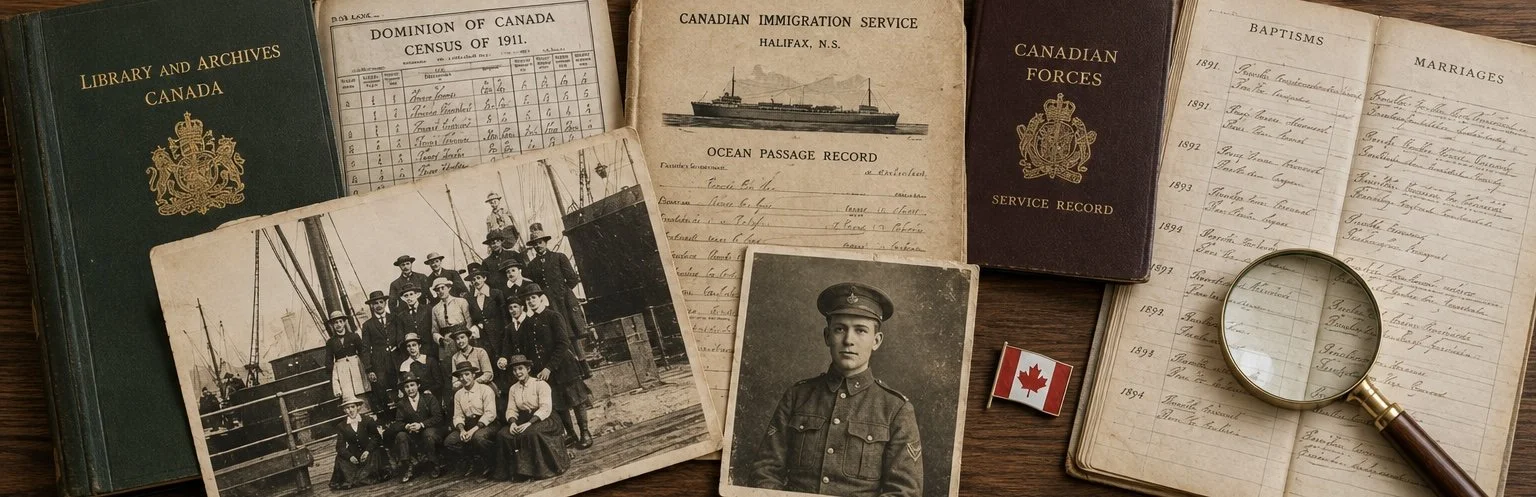
Tracing Family Lines and Mental Health Contexts Across Generations in Canada
Genealogy is usually associated with family trees, birth certificates, historical records, old photographs, and DNA matches. Yet researching our ancestors can become much more than a search for names and dates. It can raise deeply personal questions: Who am I? Where do I belong? What did my family survive? And how has the past shaped the person I am today?
These questions help explain the potential connection between mental health and genealogy.
Research specifically testing genealogy as a mental-health intervention remains limited. However, related research into family-history knowledge, reminiscence, life review, autobiographical memory, and unexpected ancestry discoveries suggests that engaging with family history can have meaningful psychological effects. Some may be positive, such as stronger identity and connection. Others can be difficult, particularly when research uncovers secrets, loss, misattributed parentage, or traumatic family events.
Genealogy, therefore, should not be presented as therapy in itself. A better way to understand it is as a potentially powerful form of personal exploration whose emotional effects depend on what we discover, how we interpret it, and the support available to us.
What Is the Connection Between Genealogy and Mental Health?
Genealogy may influence mental well-being by helping people place their lives within a broader family narrative. Learning about previous generations can create a sense of continuity between the past and present and may encourage conversations with relatives that strengthen family relationships.
There is some direct research in this area. Researchers at Brigham Young University have examined whether conducting family-history research is associated with psychological outcomes such as family identification, self-esteem, anxiety, resilience, and locus of control. Their work is particularly relevant because it attempts to move beyond simply asking whether people who know more about their families also happen to report better well-being.
However, this evidence should not be overstated. Genealogy itself has not been established as a treatment for depression, anxiety, trauma, or other mental-health conditions.
Instead, several mechanisms related to genealogical research deserve attention: identity, family storytelling, reminiscence, social connection, and meaning-making.
Genealogy, Identity, and the Story of Who We Are
A family tree provides information, but its psychological importance often comes from the story surrounding that information.
Imagine discovering that a great-grandparent migrated thousands of miles with very little money, raised a family after losing a spouse, or rebuilt life following war or economic hardship. The discovery does not automatically make someone more resilient. But it can change the context in which that person understands their own family.
Instead of viewing themselves as an isolated individual, they may begin to see their life as one chapter in a much longer narrative.
Family-history research can also help answer questions about cultural origins, migration, occupations, communities, names, and relationships. For people who feel disconnected from their background, finding documentary evidence about previous generations can make an abstract past feel more concrete.
That sense of identity can be valuable—but genealogy can also complicate identity. Records and DNA tests sometimes reveal that long-held family narratives are incomplete or incorrect. A discovery may challenge assumptions about parentage, ethnicity, nationality, or family relationships.
The psychological impact, therefore, can move in either direction.
Family Stories and a Sense of Belonging
One frequently discussed area of research concerns how much children and adolescents know about their families.
Psychologist Robyn Fivush has described research from the Family Narratives Lab indicating that young people who know more family stories tend to show better outcomes across several measures of well-being. Importantly, Fivush emphasizes that simply memorizing facts is not the key. The process of families sharing stories appears to be what matters.
This distinction is highly relevant to genealogy.
A question such as “Where was my grandmother born?” can produce a factual answer. But it can also begin a conversation:
Why did she leave? What was her childhood like? What happened when she arrived? What did she miss? What did she teach her children?
That conversation transforms genealogy from data collection into storytelling.
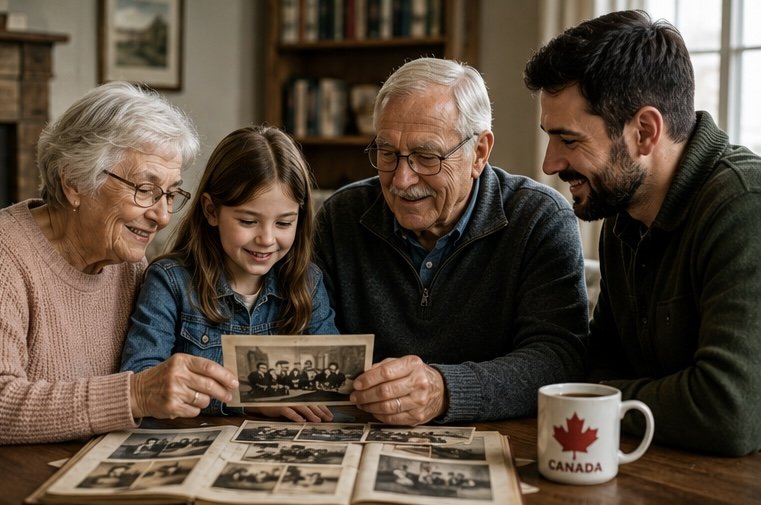
For some families, researching ancestry becomes a shared project involving parents, grandparents, siblings, cousins, and younger generations. Old photographs are identified. Forgotten stories resurface. Relatives who rarely talk about the past suddenly have something specific to discuss.
Genealogy may therefore support connection not because a family tree possesses therapeutic properties, but because family history creates opportunities for meaningful conversation and shared memory.
Reminiscence, Memory, and Emotional Well-Being
One of the strongest bodies of adjacent evidence comes from research into reminiscence therapy and life review, particularly among older adults.
Reminiscence involves deliberately recalling and discussing previous experiences, sometimes using photographs, objects, music, or significant life events as prompts. This overlaps with many ordinary genealogy activities, although formal reminiscence therapy and recreational genealogy should not be treated as the same thing.
A 2023 systematic review and meta-analysis involving 27 studies and 1,755 older adults without obvious cognitive impairment found that reminiscence therapy was associated with reduced depressive symptoms and improved life satisfaction. The researchers nevertheless called for larger, better-designed studies with longer follow-up periods.
Another 2023 meta-analysis examined 32 studies involving 2,353 participants and found that life review and reminiscence interventions were associated with improvements in quality of life and life satisfaction among older adults.
More recent evidence adds an important note of caution. A 2025 umbrella review brought together 21 systematic reviews and meta-analyses covering 246 randomized controlled trials and 18,177 participants. It found possible benefits for outcomes including self-esteem, loneliness, communication, and functional activities, but results for several other outcomes were mixed. Crucially, the methodological quality of the included reviews was generally poor.
The evidence therefore suggests potential benefits from structured reminiscence, but it does not prove that building a family tree will improve someone’s mental health.
Still, the overlap is intriguing. Genealogists routinely use photographs, letters, family objects, places, dates, and stories to prompt autobiographical memories—the same broad territory explored by reminiscence research.
How Genealogy May Help With Loneliness
Genealogy may appear to be a solitary activity: one person sitting at a computer searching records.
In practice, it can also be highly social.
Research may lead someone to call an older relative, contact a cousin, visit an archive, join a historical society, participate in an online genealogy group, or collaborate with distant relatives.
This matters because social connection is closely related to well-being.
Research on structured reminiscence provides some relevant evidence. A 2025 pilot study of 52 community-dwelling older adults examined a 10-week group reminiscence program. Participants in the intervention showed improvements in aspects of autobiographical memory and life satisfaction and reported reduced loneliness.
Again, a genealogy club is not reminiscence therapy. But the findings support a plausible idea: remembering and discussing life stories with other people may have social as well as cognitive and emotional value.
For an older adult in particular, genealogy can also create a meaningful role. They may become the person who identifies people in photographs, explains family traditions, remembers old addresses, or preserves stories younger relatives have never heard.
That can turn family history into an intergenerational exchange rather than a private hobby.
When Genealogy Becomes Emotionally Difficult
The positive side of genealogy receives considerable attention, but family-history research can also uncover information that is painful or destabilizing.
A researcher might discover:
an adoption that was never discussed;
previously unknown siblings;
infidelity or misattributed parentage;
suicide, institutionalization, abuse, or addiction in earlier generations;
abandonment or family estrangement;
persecution, displacement, slavery, war, or genocide;
evidence contradicting a treasured family story.
Sometimes the researcher expects a historical answer and instead encounters a present-day emotional problem.
Unexpected DNA Results
Direct-to-consumer DNA testing has made this issue particularly important.
A qualitative study published in 2025 examined the experiences of 52 people who learned “not parent expected” information through direct-to-consumer ancestry DNA testing.
Participants commonly described shock and disruption to their sense of identity. The researchers identified themes involving mental-health effects, family relationship difficulties, grief, loss, and trauma. Participants often turned to spouses, siblings, peer-support communities, and mental-health professionals for help.
These experiences demonstrate why genealogy should not automatically be portrayed as psychologically beneficial.
Consider a hypothetical example: someone takes a DNA test hoping to learn whether their ancestors came from a particular region. Instead, the results suggest that the man they have always known as their biological father is not genetically related to them.
The discovery does not merely alter one branch of a family tree.
It may affect relationships with parents and siblings, medical-history assumptions, ethnic identity, childhood memories, and the person’s understanding of their own life.
The genealogy is factual. The consequences are emotional.
Grief, Trauma, and Painful Family Histories
Historical research can also bring people unexpectedly close to tragedy.
A death certificate may reveal a cause of death that was never discussed. A newspaper archive might describe a violent event. Military records can document a young ancestor’s death. Institutional records may expose illness or hardship.
Some discoveries may produce grief for people the researcher never personally knew.
Others can reopen existing family wounds.
It is useful to distinguish learning about ancestral hardship from inheriting a specific psychological condition because of that hardship. Family patterns can involve complex interactions among genetics, environment, relationships, culture, socioeconomic conditions, and individual experiences.
A family tree can reveal patterns worth thinking about. It cannot diagnose their cause.
A Healthier Way to Explore Family History
Genealogy can be emotionally rewarding without requiring every discovery to become a psychological investigation.
A few practices can help keep the experience grounded:
Start with curiosity rather than expectations. Family history often contradicts family legend.
Separate evidence from interpretation. A historical record can establish certain facts, but it rarely tells us exactly what someone thought or felt.
Respect living relatives’ boundaries. A discovery that feels exciting to one person may feel deeply private to another.
Prepare for DNA surprises. Genetic testing can reveal biological relationships that were previously unknown.
Record stories as well as dates. Ask relatives about places, traditions, work, relationships, turning points, and ordinary daily life.
Take breaks when research becomes overwhelming. There is no requirement to resolve every family mystery immediately.
Seek appropriate support for distressing discoveries. Persistent anxiety, grief, identity disruption, or trauma following a genealogy discovery may be worth discussing with a qualified mental-health professional.
Genealogy works best when uncertainty is allowed to remain uncertainty. Not every gap in a historical record can be filled, and not every family story can be verified.
Frequently Asked Questions
Can genealogy improve mental health?
Genealogy may support identity, connection, meaning-making, and family communication for some people. Related research on family narratives and reminiscence suggests potential psychological benefits. However, genealogy itself is not an established mental-health treatment.
Can learning about your ancestors help with identity?
Yes, it can help some people understand cultural background, migration, family relationships, and the experiences that shaped previous generations. Genealogy can also complicate identity when discoveries contradict existing beliefs about ancestry or parentage.
Is genealogy good for older adults?
Genealogy can encourage memory sharing, conversation, learning, and intergenerational connection. Research on reminiscence and life-review interventions among older adults has reported some positive outcomes, although this does not establish genealogy itself as a therapeutic intervention.
Can DNA ancestry testing affect mental health?
Yes. Most results may be relatively ordinary, but unexpected discoveries about biological relationships can cause substantial distress. Research involving people who received unexpected parentage information has documented shock, grief, identity disruption, and family conflict.
Can genealogy uncover generational trauma?
Genealogy can uncover evidence of traumatic events experienced by previous generations, such as war, displacement, persecution, premature death, or family separation. Determining how historical trauma affects later generations psychologically is much more complex and should not be inferred from a family tree alone.
Why are family stories important?
Family stories provide context that names and dates cannot. Research on family narratives suggests that knowing and discussing family stories is associated with aspects of well-being among young people. Researchers emphasize the importance of the storytelling process rather than simply knowing factual answers.
Can genealogy help with loneliness?
Potentially. Genealogy can encourage contact with relatives, community groups, archives, and other researchers. Evidence from structured group reminiscence studies also suggests that shared remembering can reduce loneliness in some older populations, although genealogy has not been proven to produce the same effect.
What should I do if a genealogy discovery causes emotional distress?
Give yourself time before making major decisions or contacting newly discovered relatives. Consider speaking with someone you trust. If the discovery causes persistent anxiety, depression, grief, trauma symptoms, or significant identity distress, a qualified mental-health professional can provide appropriate support.
Conclusion
The connection between mental health and genealogy is more nuanced than the idea that researching ancestors simply “makes us feel better.”
Family-history research can strengthen a sense of identity, encourage meaningful conversations, reconnect relatives, preserve memories, and place individual experiences within a broader human story. Research on family narratives, life review, and reminiscence provides plausible evidence for some of these benefits.
But genealogy can also uncover information capable of disrupting identity and relationships. Research into unexpected DNA parentage discoveries illustrates just how psychologically significant ancestry information can become.
Perhaps the most valuable aspect of genealogy is therefore not finding a perfectly complete family tree. It is gaining a more informed understanding of the people, relationships, experiences, and stories that preceded us—while recognizing that discovering the past can produce both connection and complexity.
Health note: This article is educational and should not be used as a substitute for professional mental-health assessment, diagnosis, or treatment.
Further Reading
Library and Archives Canada — Genealogy and Family History
Canada’s primary federal starting point for genealogy resources, including census, immigration, citizenship, military and vital-record research. (Library and Archives Canada)
Explore Library and Archives Canada genealogy resources
Public Health Agency of Canada — Social Isolation, Loneliness and Positive Mental Health
Canadian research examining loneliness, social isolation, community belonging, life satisfaction and self-rated mental health among adults aged 65 and older. (Canada)
Read the Canadian study
Government of Canada — Seniors’ Loneliness in Canada
A 2026 federal research summary examining loneliness among older Canadians and the importance of accessible social activities and community belonging. (Canada)
Read Seniors’ Loneliness in Canada
Public Health Agency of Canada — Life Changes Experienced by Older Adults
Canadian guidance emphasizing social connections when coping with major transitions later in life. (Canada)
Read the Government of Canada guidance
International Supporting Evidence — Genealogy and Psychological Well-Being
A 2023 study of university students reported associations between participation in family-history research and measures including family identification, self-esteem and anxiety. The population was not Canadian, so the results should not automatically be generalized to Canadians. (BYU ScholarsArchive)
International Supporting Evidence — Reminiscence
A 2023 systematic review and meta-analysis of 27 studies involving 1,755 older adults found evidence of effects on depression and life satisfaction. This supports discussion of reminiscence rather than proving a therapeutic effect from genealogy itself. (PubMed)